Creating opportunities for children to engage with food in ways that are meaningful, safe and appropriate.
For many children, having food available is not the same as being able to eat it, enjoy it or participate in the experiences that surround it.
Across health, education and food policy, significant effort is rightly invested in improving the quality, availability and nutritional value of food. However, far less attention is given to whether children can access, engage with and benefit from that food in meaningful ways.
For children with feeding difficulties, neurodevelopmental differences, disability or complex medical needs, barriers to participation can exist long before a meal begins.
The F.E.D. Foundation exists to help bridge that gap.
Food participation is the ability to take part in food-related experiences in ways that are meaningful, safe and appropriate for each child.
It is not simply about what a child eats. It is about whether children can:
Food participation recognises that feeding development influences much more than nutrition. It influences learning, relationships, inclusion, independence and quality of life.
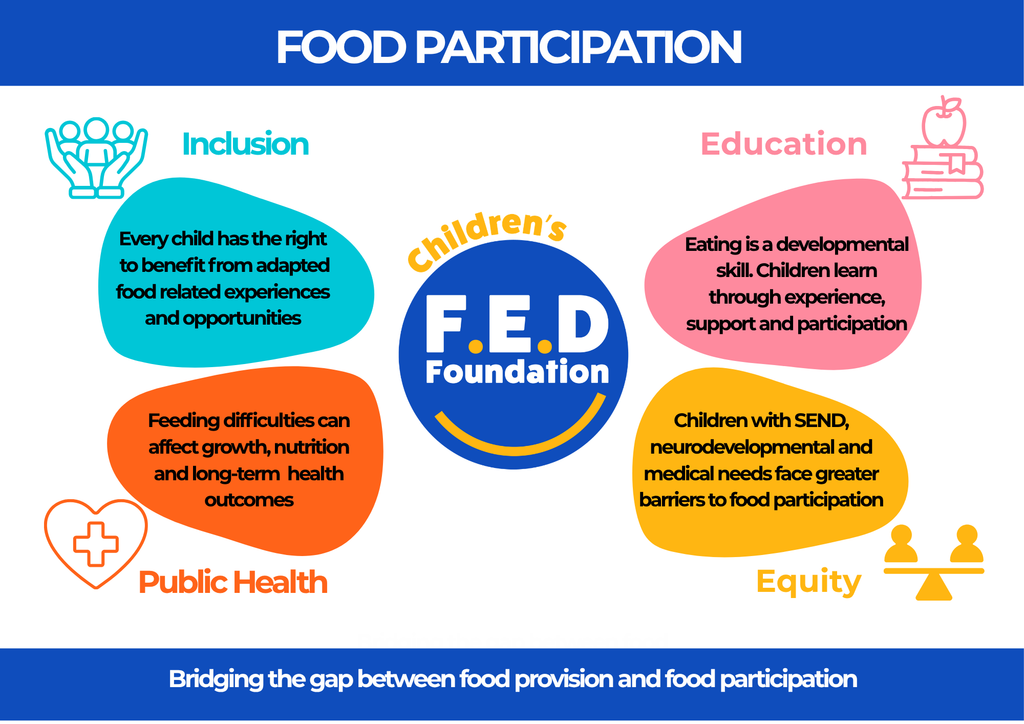
When feeding difficulties are viewed purely through a nutritional or medical lens, children can miss out on important opportunities for development and inclusion.
For many children, the greatest challenge is not the food itself. It is participating in the environments where food is part of everyday life.
This may affect:
Participation matters because children learn through doing. The same principle applies to feeding development.
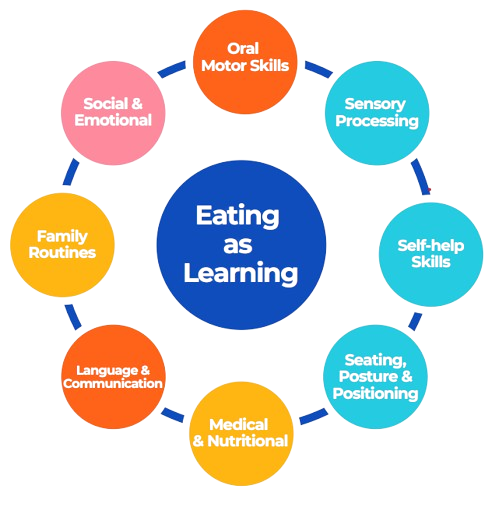
Understanding food participation led directly to the development of the Eating as Learning Framework. Children learn to eat through the interaction of:
The Framework helps parents, practitioners and educators understand feeding as a developmental process rather than a simple outcome measured by food intake alone.
By focusing on participation, strengths and skill development, the Framework supports a more inclusive and realistic understanding of feeding progress.
The Parent Community helps families understand feeding development, build confidence and support participation within everyday routines and experiences.
The Eating as Learning Framework provides a developmental and participation-focused approach to assessment, intervention and parent partnership. Through training, supervision and professional networks, practitioners are supported to apply the framework within clinical practice.
The Eating as Learning Curriculum translates feeding development into practical learning opportunities within schools and early years settings. Rather than focusing solely on what children eat, the curriculum helps educational settings support:
This creates opportunities for children to build feeding skills through everyday educational experiences.
Access expert guidance and practical strategies to support children and young people.
We’re putting the finishing touches to our membership. Please check back soon.
The Foundation regularly works alongside other charities and community organisations to ensure families can access relevant support and opportunities to get involved.
Examples include:
Positive About Down Syndrome (PADS)
The Foundation worked with PADS to develop a parent webinar exploring feeding development and eating challenges experienced by some children with Down syndrome.
Autism West Midlands
Through workshops and learning events, families have been able to explore topics relating to feeding differences, participation and neurodevelopment.
Worcestershire Parent Carer Forum
Partnership work with Worcestershire Parent Carer Forum has provided opportunities to hear family perspectives, support local engagement activities and strengthen conversations around feeding development, SEND and inclusion.
Interested in becoming a partner organisation?